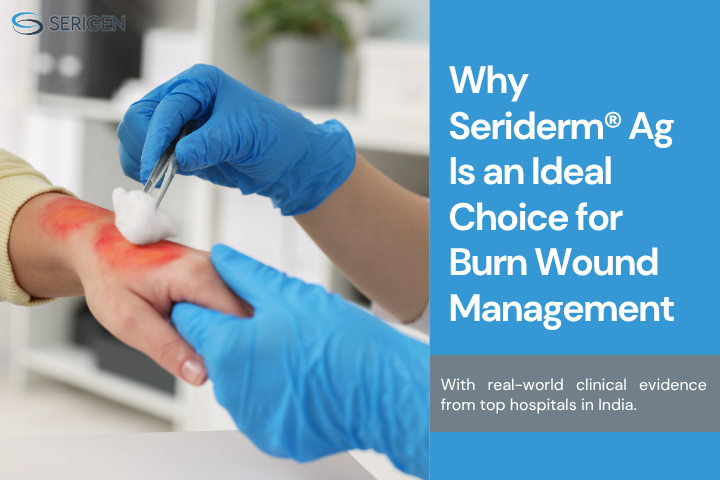
Burn injuries are among the most complex and painful wounds encountered in clinical practice. Whether caused by thermal exposure, scalding liquids, or chemical contact, burns disrupt multiple layers of the skin simultaneously, compromising the body’s primary barrier against infection, fluid loss, and environmental harm. Selecting the right wound dressing for burns is a central pillar of the entire treatment strategy.
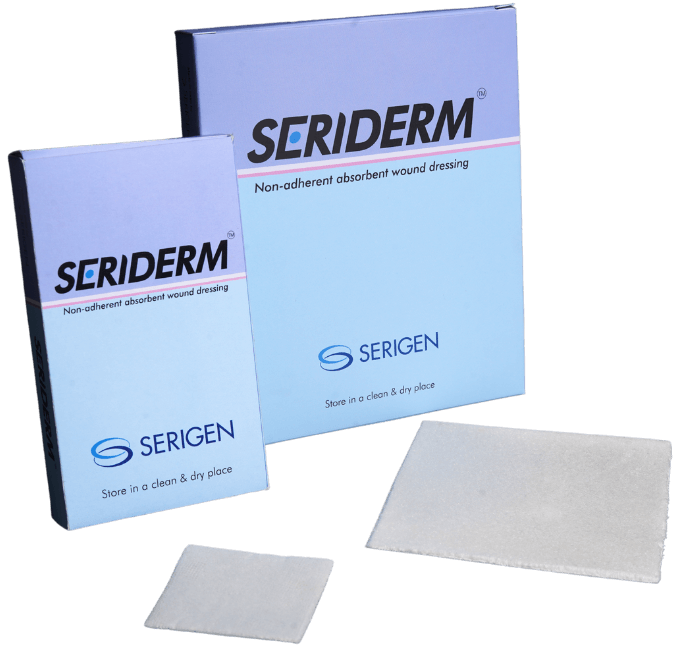
Advanced wound dressings have transformed burn care outcomes significantly over the past decade, reducing the need for surgical intervention, minimising patient discomfort, and accelerating the wound healing process. Seriderm® Ag, Serigen’s next-generation wound dressing powered by 100% Silk Protein and the antimicrobial action of silver Ions, has emerged as a highly effective solution across a wide spectrum of burn indications.
This article explores the unique challenges of burn wound management, the attributes an ideal dressing must possess, and how Seriderm® Ag addresses these requirements, supported by real-world case outcomes from clinical practice.
Why Burn Wounds Demand Specialised Wound Care
Burns are not homogeneous injuries. Their clinical behaviour, and therefore the management approach, varies significantly based on depth, surface area, anatomical location, patient age, and the presence of infection.
- Superficial (first-degree) burns affect only the epidermis. These typically heal within 7–10 days with conservative management.
- Partial thickness (second-degree) burns extend into the dermis and are further categorised as superficial partial thickness or deep partial thickness, the latter carrying a higher risk of scarring and infection.
- Full-thickness (third-degree) burns destroy the entire dermis and may involve underlying tissue, almost always requiring surgical intervention such as skin grafting.
Total Body Surface Area (TBSA) is another critical parameter. Burns exceeding 20% TBSA in adults, or significantly less in paediatric patients, are considered major burns and carry an elevated risk of systemic complications.
Beyond classification, the physiological environment of a burn wound presents several compounding challenges that any effective wound dressing must address:
- High infection risk: The loss of the skin barrier exposes underlying tissue to microbial colonisation. Bacterial biofilm formation on burn wounds is a leading cause of delayed healing and graft failure.
- Exudate management: Burn wounds — particularly partial thickness injuries — produce significant volumes of exudate during the inflammatory phase. Poorly managed exudate creates a macerated, infection-prone wound bed.
- Pain during dressing changes: Frequent dressing changes are a major source of procedural pain in burn patients, particularly in paediatric cases. Adherent dressings that disturb the healing tissue during removal are a significant clinical concern.
- Risk of scarring and contracture: The regeneration of skin in burn wounds can result in hypertrophic scarring or contracture if the wound healing environment is suboptimal. Maintaining a moist, protected environment is critical to minimising these outcomes.
- Donor site management in grafting cases: When skin grafting is required, the donor site — from which a split-thickness skin graft (STSG) is harvested — itself becomes an acute wound requiring careful management.
What an Ideal Wound Dressing for Burns Must Provide
Given the complexity of burn wounds, the ideal dressing must fulfil a demanding set of criteria simultaneously:
- Effective antimicrobial protection to prevent and combat infection without systemic medication
- Moisture balance — maintaining a moist wound environment to support healing while absorbing excess exudate
- Non-adherence to the wound bed to ensure atraumatic, pain-free removal during dressing changes
- Biocompatibility with no cytotoxic effects on regenerating tissue
- Prolonged wear time to reduce the frequency of dressing changes and minimise procedural disruption
- Support for skin regeneration by providing a scaffold-like environment that encourages cellular regrowth
- Suitability across patient populations, including paediatric patients, where tolerability and non-toxicity are especially critical
How Seriderm® Ag Meets These Requirements
Seriderm® Ag is built on Serigen’s proprietary silk protein technology, with Silver Ions incorporated to deliver broad-spectrum antimicrobial activity. Together, these two components create a wound dressing uniquely suited to the demanding environment of burn wound management.
100% Silk Protein in the Wound Contact Layer
Silk proteins — derived from Bombyx mori silkworm — are a biomaterial with an exceptional combination of properties that make it highly suitable for advanced wound care applications:
- Biocompatibility: Silk protein is naturally accepted by the body with no toxic effects / allergic reaction, making it safe for use on fragile, regenerating tissue.
- Non-adherent wound interface: The silk protein wound contact layer does not adhere to the wound bed, allowing unhindered wound healing and atraumatic dressing changes — a critical attribute for burn patients, particularly children.
- Moisture regulation: Silk proteins support a moist wound environment at the wound interface while the outer layers of the dressing manage exudate absorption, creating an optimal healing microenvironment.
- Modulation of cellular activity for skin regeneration: The silk proteins modulate cellular activity and facilitate the regeneration of dermal tissue, including promoting fibroblast proliferation, neovascularization and new blood vessel formation.
Antimicrobial Action of Silver Ions
Silver ions (Ag⁺) exert a multi-modal antimicrobial effect by disrupting bacterial cell membranes, interfering with enzyme activity, and inhibiting DNA replication across a broad spectrum of organisms, including antibiotic-resistant strains. Unlike silver nanoparticles, ionic silver releases in a controlled, sustained manner — providing prolonged antimicrobial protection without reliance on systemic antibiotics. Notably, all antibiotic-resistant bacteria isolated from burn wounds in one study showed susceptibility to ionic silver dressings, underscoring its value in high-risk wound environments.
This combination — silk protein for biocompatible, regeneration-supportive wound healing, and silver ions for infection control — makes Seriderm® Ag a comprehensive, single-product solution for burn wound management.
Clinical Evidence: Case Reports from the Field
The following cases demonstrate the real-world performance of Seriderm® Ag across a range of burn indications, from paediatric scald burns to donor site management post-grafting.
Case 1: Paediatric Scald Burn (30% TBSA) — Complete Healing Without Grafting
Patient: 5-year-old male Condition: Hot water scald burn — 30% Total Body Surface Area (TBSA)
Treatment: A single Seriderm® Ag dressing was applied on Day 1 and maintained for 13 days, after which a standard dressing was applied for the remainder of the healing period.
Outcome: Complete, scar-free healing was achieved by Day 25 — ahead of the initial 30-day clinical estimate. No skin grafting was required, and no concomitant medications or topical agents were prescribed. The patient reported no pain or discomfort during dressing changes throughout the treatment course.
Clinical Significance: A 30% TBSA burn in a paediatric patient is a serious injury that frequently necessitates surgical grafting. The ability of Seriderm® Ag to support healing to completion without grafting — while also achieving scar-free results faster than anticipated — underscores its value in managing extensive burns non-surgically, particularly in children where minimising procedural intervention is a high clinical priority.
Case 2: Infant Oil Burn (17% TBSA) — Healing Achieved with a Single Dressing Application
Patient: 6-month-old male Condition: Acute superficial burn injury (hot oil exposure) — 17% TBSA
Treatment: A single Seriderm® Ag dressing was applied and maintained for 10 days, with no additional medications or topical agents.
Outcome: Significant healing with granulation tissue formation was observed at Day 10. No grafting was required. The patient remained comfortable and pain-free throughout.
Clinical Significance: Burns in infants present an especially high-stakes management challenge. The infant’s developing skin, limited surface area, and heightened sensitivity to pain and medication all constrain the available treatment options. Seriderm® Ag’s non-adherent silk protein contact layer ensured tolerability in this particularly vulnerable patient, while the silver ions provided antimicrobial coverage without the need for systemic medication. Complete management with a single dressing change in a 6-month-old represents a meaningful clinical achievement.
Case 3: Thermal Burn (40% TBSA) — Donor Site Management Post-Grafting
Patient: 4-year-old male Condition: Anterior surface thermal burns — 40% TBSA; Seriderm® Ag used on the Split-Thickness Skin Graft (STSG) donor site
Treatment: A single Seriderm® Ag dressing was applied to the donor site on Day 1 and maintained for 21 days. No topical agents or systemic medications were required.
Outcome: Effective healing of the donor site was observed over 21 days. The patient experienced no discomfort or pain during or after dressing application.
Clinical Significance: In cases requiring skin grafting for extensive burns, donor site management is a critical — and often under emphasised — component of the overall care plan. A donor site is an acute wound that, if poorly managed, can itself become a source of infection or significant morbidity. Seriderm® Ag’s prolonged wear time (21 days with a single dressing) reduced the frequency of potentially painful dressing change procedures, while its antimicrobial and moisture-retaining properties supported an optimal healing environment at the harvest site.
Indications for Seriderm® Ag in Burn Care for Seriderm® Ag in Burn Care
Based on clinical evidence and product design, Seriderm® Ag is indicated across the following burn-related wound types:
- Second-degree burns (superficial and partial thickness)
- Scald burns in paediatric and adult patients
- Thermal burn wounds not requiring primary grafting
- STSG donor sites in post-grafting management
- Wound bed preparation for grafting in larger burns
- Infected or high-risk burn wounds requiring antimicrobial intervention
Conclusion
Effective burn wound management demands a dressing that can simultaneously address infection risk, support active tissue regeneration, manage wound moisture, and deliver patient comfort — across a highly variable range of burn types and patient populations. Seriderm® Ag, with its unique combination of 100% Silk Protein in the wound contact layer and the sustained antimicrobial action of Silver Ions, is designed precisely to meet this demand.
Clinical outcomes from real-world practice confirm that Seriderm® Ag can support healing in paediatric and adult patients with partial thickness burns, reduce or eliminate the need for grafting, and provide effective donor site management — often with a single dressing application and without the need for concurrent medications.
For clinicians seeking an advanced, evidence-supported wound dressing for burns, Seriderm® Ag represents a significant step forward in burn wound care.
 Author Bio – Dr. Rucha Deshpade is Senior Manager at Serigen Mediproducts. She holds a PhD in Zoology from the National Center for Cell Science and the University of Pune and has 10 years of professional experience in molecular biology, biomaterials, and cell biology.
Wound Dressing for Burns: Why Seriderm® Ag Is an Ideal Choice for Burn Wound Management
Burn injuries are among the most complex and painful wounds encountered in clinical practice. Whether caused by thermal exposure, scalding liquids, or chemical contact, burns disrupt multiple layers of the skin simultaneously, compromising the body’s primary barrier against infection, fluid loss, and environmental harm. Selecting the right wound dressing for burns is a central pillar of the entire treatment strategy.
Advanced wound dressings have transformed burn care outcomes significantly over the past decade, reducing the need for surgical intervention, minimising patient discomfort, and accelerating the wound healing process. Seriderm® Ag, Serigen’s next-generation wound dressing powered by 100% Silk Protein and the antimicrobial action of silver Ions, has emerged as a highly effective solution across a wide spectrum of burn indications.
This article explores the unique challenges of burn wound management, the attributes an ideal dressing must possess, and how Seriderm® Ag addresses these requirements, supported by real-world case outcomes from clinical practice.
Why Burn Wounds Demand Specialised Wound Care
Burns are not homogeneous injuries. Their clinical behaviour, and therefore the management approach, varies significantly based on depth, surface area, anatomical location, patient age, and the presence of infection.
- Superficial (first-degree) burns affect only the epidermis. These typically heal within 7–10 days with conservative management.
- Partial thickness (second-degree) burns extend into the dermis and are further categorised as superficial partial thickness or deep partial thickness, the latter carrying a higher risk of scarring and infection.
- Full-thickness (third-degree) burns destroy the entire dermis and may involve underlying tissue, almost always requiring surgical intervention such as skin grafting.
Total Body Surface Area (TBSA) is another critical parameter. Burns exceeding 20% TBSA in adults, or significantly less in paediatric patients, are considered major burns and carry an elevated risk of systemic complications.
Beyond classification, the physiological environment of a burn wound presents several compounding challenges that any effective wound dressing must address:
- High infection risk: The loss of the skin barrier exposes underlying tissue to microbial colonisation. Bacterial biofilm formation on burn wounds is a leading cause of delayed healing and graft failure.
- Exudate management: Burn wounds — particularly partial thickness injuries — produce significant volumes of exudate during the inflammatory phase. Poorly managed exudate creates a macerated, infection-prone wound bed.
- Pain during dressing changes: Frequent dressing changes are a major source of procedural pain in burn patients, particularly in paediatric cases. Adherent dressings that disturb the healing tissue during removal are a significant clinical concern.
- Risk of scarring and contracture: The regeneration of skin in burn wounds can result in hypertrophic scarring or contracture if the wound healing environment is suboptimal. Maintaining a moist, protected environment is critical to minimising these outcomes.
- Donor site management in grafting cases: When skin grafting is required, the donor site — from which a split-thickness skin graft (STSG) is harvested — itself becomes an acute wound requiring careful management.
What an Ideal Wound Dressing for Burns Must Provide
Given the complexity of burn wounds, the ideal dressing must fulfil a demanding set of criteria simultaneously:
- Effective antimicrobial protection to prevent and combat infection without systemic medication
- Moisture balance — maintaining a moist wound environment to support healing while absorbing excess exudate
- Non-adherence to the wound bed to ensure atraumatic, pain-free removal during dressing changes
- Biocompatibility with no cytotoxic effects on regenerating tissue
- Prolonged wear time to reduce the frequency of dressing changes and minimise procedural disruption
- Support for skin regeneration by providing a scaffold-like environment that encourages cellular regrowth
- Suitability across patient populations, including paediatric patients, where tolerability and non-toxicity are especially critical
How Seriderm® Ag Meets These Requirements
Seriderm® Ag is built on Serigen’s proprietary silk protein technology, with Silver Ions incorporated to deliver broad-spectrum antimicrobial activity. Together, these two components create a wound dressing uniquely suited to the demanding environment of burn wound management.
100% Silk Protein in the Wound Contact Layer
Silk proteins — derived from Bombyx mori silkworm — are a biomaterial with an exceptional combination of properties that make it highly suitable for advanced wound care applications:
- Biocompatibility: Silk protein is naturally accepted by the body with no toxic effects / allergic reaction, making it safe for use on fragile, regenerating tissue.
- Non-adherent wound interface: The silk protein wound contact layer does not adhere to the wound bed, allowing unhindered wound healing and atraumatic dressing changes — a critical attribute for burn patients, particularly children.
- Moisture regulation: Silk proteins support a moist wound environment at the wound interface while the outer layers of the dressing manage exudate absorption, creating an optimal healing microenvironment.
- Modulation of cellular activity for skin regeneration: The silk proteins modulate cellular activity and facilitate the regeneration of dermal tissue, including promoting fibroblast proliferation, neovascularization and new blood vessel formation.
Antimicrobial Action of Silver Ions
Silver ions (Ag⁺) exert a multi-modal antimicrobial effect by disrupting bacterial cell membranes, interfering with enzyme activity, and inhibiting DNA replication across a broad spectrum of organisms, including antibiotic-resistant strains. Unlike silver nanoparticles, ionic silver releases in a controlled, sustained manner — providing prolonged antimicrobial protection without reliance on systemic antibiotics. Notably, all antibiotic-resistant bacteria isolated from burn wounds in one study showed susceptibility to ionic silver dressings, underscoring its value in high-risk wound environments.
This combination — silk protein for biocompatible, regeneration-supportive wound healing, and silver ions for infection control — makes Seriderm® Ag a comprehensive, single-product solution for burn wound management.
Clinical Evidence: Case Reports from the Field
The following cases demonstrate the real-world performance of Seriderm® Ag across a range of burn indications, from paediatric scald burns to donor site management post-grafting.
Case 1: Paediatric Scald Burn (30% TBSA) — Complete Healing Without Grafting
Patient: 5-year-old male Condition: Hot water scald burn — 30% Total Body Surface Area (TBSA)
Treatment: A single Seriderm® Ag dressing was applied on Day 1 and maintained for 13 days, after which a standard dressing was applied for the remainder of the healing period.
Outcome: Complete, scar-free healing was achieved by Day 25 — ahead of the initial 30-day clinical estimate. No skin grafting was required, and no concomitant medications or topical agents were prescribed. The patient reported no pain or discomfort during dressing changes throughout the treatment course.
Clinical Significance: A 30% TBSA burn in a paediatric patient is a serious injury that frequently necessitates surgical grafting. The ability of Seriderm® Ag to support healing to completion without grafting — while also achieving scar-free results faster than anticipated — underscores its value in managing extensive burns non-surgically, particularly in children where minimising procedural intervention is a high clinical priority.
Case 2: Infant Oil Burn (17% TBSA) — Healing Achieved with a Single Dressing Application
Patient: 6-month-old male Condition: Acute superficial burn injury (hot oil exposure) — 17% TBSA
Treatment: A single Seriderm® Ag dressing was applied and maintained for 10 days, with no additional medications or topical agents.
Outcome: Significant healing with granulation tissue formation was observed at Day 10. No grafting was required. The patient remained comfortable and pain-free throughout.
Clinical Significance: Burns in infants present an especially high-stakes management challenge. The infant’s developing skin, limited surface area, and heightened sensitivity to pain and medication all constrain the available treatment options. Seriderm® Ag’s non-adherent silk protein contact layer ensured tolerability in this particularly vulnerable patient, while the silver ions provided antimicrobial coverage without the need for systemic medication. Complete management with a single dressing change in a 6-month-old represents a meaningful clinical achievement.
Case 3: Thermal Burn (40% TBSA) — Donor Site Management Post-Grafting
Patient: 4-year-old male Condition: Anterior surface thermal burns — 40% TBSA; Seriderm® Ag used on the Split-Thickness Skin Graft (STSG) donor site
Treatment: A single Seriderm® Ag dressing was applied to the donor site on Day 1 and maintained for 21 days. No topical agents or systemic medications were required.
Outcome: Effective healing of the donor site was observed over 21 days. The patient experienced no discomfort or pain during or after dressing application.
Clinical Significance: In cases requiring skin grafting for extensive burns, donor site management is a critical — and often under emphasised — component of the overall care plan. A donor site is an acute wound that, if poorly managed, can itself become a source of infection or significant morbidity. Seriderm® Ag’s prolonged wear time (21 days with a single dressing) reduced the frequency of potentially painful dressing change procedures, while its antimicrobial and moisture-retaining properties supported an optimal healing environment at the harvest site.
Indications for Seriderm® Ag in Burn Care for Seriderm® Ag in Burn Care
Based on clinical evidence and product design, Seriderm® Ag is indicated across the following burn-related wound types:
- Second-degree burns (superficial and partial thickness)
- Scald burns in paediatric and adult patients
- Thermal burn wounds not requiring primary grafting
- STSG donor sites in post-grafting management
- Wound bed preparation for grafting in larger burns
- Infected or high-risk burn wounds requiring antimicrobial intervention
Conclusion
Effective burn wound management demands a dressing that can simultaneously address infection risk, support active tissue regeneration, manage wound moisture, and deliver patient comfort — across a highly variable range of burn types and patient populations. Seriderm® Ag, with its unique combination of 100% Silk Protein in the wound contact layer and the sustained antimicrobial action of Silver Ions, is designed precisely to meet this demand.
Clinical outcomes from real-world practice confirm that Seriderm® Ag can support healing in paediatric and adult patients with partial thickness burns, reduce or eliminate the need for grafting, and provide effective donor site management — often with a single dressing application and without the need for concurrent medications.
For clinicians seeking an advanced, evidence-supported wound dressing for burns, Seriderm® Ag represents a significant step forward in burn wound care.
Author Bio – Dr. Rucha Deshpade is Senior Manager at Serigen Mediproducts. She holds a PhD in Zoology from the National Center for Cell Science and the University of Pune and has 10 years of professional experience in molecular biology, biomaterials, and cell biology.